 Masstamilanweb.com
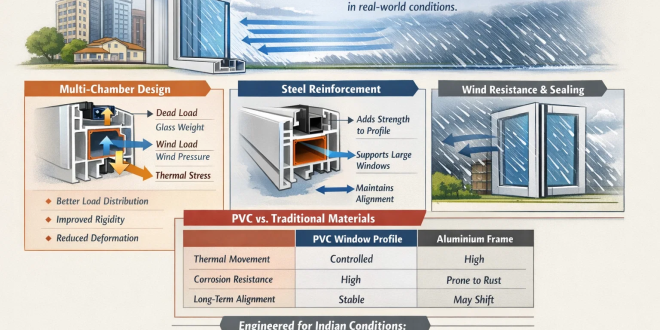
If you have ever stood near a window during heavy wind or monsoon rain, you know the pressure a window system helps manage. Frames flex, glass vibrates, and poorly designed profiles begin to show their limits. Over time, this leads to air leakage, misalignment, or even failure. This is why structural performance matters when choosing a window PVC profile.
Across residential towers, commercial buildings, and mixed-use projects, demand for a window PVC profile in India has grown because it offers predictable strength, weather resistance, and long-term stability under real site conditions.
What Is a Window PVC Profile?
A window PVC profile is an extruded plastic section used to form the frame and sash of a window system. It holds the glass, transfers load to the structure, and maintains alignment under daily stress.
In practical use, it must:
- Support glass weight
- Resist wind pressure
- Maintain shape over time
- Seal against air and water
The profile design does most of the heavy lifting long before glass or hardware comes into play.
Understanding the Loads a Window Must Handle
Windows face more stress than most people realise. These forces act daily, not occasionally.
Key loads include:
- Dead load from glass weight
- Wind load from pressure and suction
- Operational load from opening and closing
- Thermal stress from temperature changes
A well-designed window PVC profile in India is engineered to handle all of these without distortion.
How PVC Profiles Manage Structural Load
Multi-Chamber Design
Modern PVC window profiles use internal chambers. These chambers improve strength without adding excessive material.
Benefits include:
- Better load distribution
- Improved rigidity
- Reduced profile deformation
This design allows the frame to carry glass weight evenly across the opening.
Steel or Reinforcement Compatibility
For large windows or high-rise buildings, reinforcement is essential.
PVC profiles are designed to:
- Accept steel or structural inserts
- Maintain alignment under load
- Support tall or wide window formats
This combination of PVC and reinforcement delivers reliable structural performance.
Wind Resistance in Real Conditions
Wind does not apply force evenly. Pressure varies across the window surface.
PVC window profiles help by:
- Maintaining tight tolerances
- Supporting strong corner joints
- Preventing frame bowing
In coastal or high-rise zones, this stability directly affects safety and comfort.
PVC Extrusion for Window Systems
The performance of a window starts at the extrusion stage. PVC extrusion for window systems allows precise control over wall thickness, chamber geometry, and reinforcement zones.
This precision ensures:
- Consistent strength across batches
- Accurate fit for seals and hardware
- Reliable performance in repeat projects
Well-controlled extrusion reduces installation issues and long-term adjustments.
Managing Structural Stress Over Time
Stress does not disappear after installation. It builds slowly.
PVC window profiles are designed to:
- Resist creep under continuous load
- Handle thermal expansion without cracking
- Maintain joint integrity at corners
This long-term behaviour is critical in buildings exposed to daily temperature swings.
Comparison: PVC Profiles vs Traditional Materials
From site experience, the difference becomes clear over years of use.
| Property | PVC Window Profile | Aluminium Frame |
| Thermal movement | Controlled | High |
| Load distribution | Even | Profile dependent |
| Corrosion resistance | High | Application dependent |
| Long-term alignment | Stable | May shift |
This comparison explains why PVC is often chosen for residential and commercial windows.
Installation Factors That Affect Load Performance
Even a strong profile can fail if installed poorly.
Installers focus on:
- Proper anchoring to the wall
- Correct reinforcement placement
- Accurate glass packing
Good installation allows the profile to perform as designed.
Custom Profiles for Project-Specific Needs
Large projects often require profiles that match specific structural requirements.
Custom PVC window profiles support:
- Wider spans
- Heavier glazing
- Unique architectural designs
Manufacturers such as M3 Extrusion produce window PVC profiles based on drawings and technical specifications, helping builders maintain consistent quality across bulk and repeat installations.
Choosing the Right Window PVC Profile in India
When selecting a window PVC profile in India, focus on engineering details, not just surface finish.
Ask practical questions:
- Is the profile designed for required wind load?
- Does it support reinforcement where needed?
- Is extrusion consistency proven across batches?
These checks reduce long-term structural issues.
Practical Takeaways for Builders and Architects
- Profile design controls load handling
- Multi-chamber structures improve rigidity
- Reinforcement supports large openings
- Precise extrusion improves consistency
- Correct installation protects performance
Frequently Asked Questions
How does a PVC window profile handle glass weight?
PVC window profiles distribute glass weight through their multi-chamber structure and reinforcement zones. This spreads load evenly across the frame, preventing sagging or distortion during long-term use in residential and commercial buildings.
Are PVC window profiles suitable for high-wind areas?
Yes, PVC window profiles are suitable for high-wind areas when designed correctly. Reinforcement, tight tolerances, and strong corner joints allow them to resist wind pressure and suction without losing alignment or sealing performance.
Do PVC window profiles need reinforcement?
Reinforcement is recommended for large windows or high-rise buildings. Steel or structural inserts increase load capacity and help the profile maintain shape under wind and operational stress over time.
How long do PVC window profiles last?
High-quality PVC window profiles can last many years with proper installation. Their resistance to corrosion, controlled thermal movement, and structural stability support long-term performance with minimal maintenance.
Can PVC window profiles handle temperature changes?
PVC window profiles are designed to manage thermal expansion. Their material properties and chamber design allow controlled movement without cracking or warping, making them suitable for varied climate conditions.
What affects the structural performance of PVC window systems?
Structural performance depends on profile design, reinforcement, extrusion quality, and installation accuracy. When all factors are aligned, PVC window systems provide reliable strength and stability over long service periods.
